What Is VPN Jurisdiction? Your Privacy Guide for 2026

VPN jurisdiction is the country where a VPN provider’s legal entity is incorporated, and it determines which courts, laws, and government agencies can compel that company to hand over user data. This single fact shapes more of your online privacy than most people realize. When you pick a VPN, you are not just choosing a server location. You are choosing a legal system. Understanding how VPN jurisdiction works helps you cut through marketing claims and make smarter decisions about your actual privacy.
What is VPN jurisdiction and why does it matter?
VPN jurisdiction defines the legal seat of a provider, not where its servers sit. A VPN company incorporated in Panama operates under Panamanian law, even if it runs servers in New York, London, and Tokyo. That distinction matters because a U.S. court order cannot compel a Panamanian company to produce data the same way it can compel a U.S.-registered business. The legal home base is where the real privacy battle is fought.
Why does this affect you directly? Every country has its own rules about data retention, surveillance, and cooperation with foreign governments. A VPN based in a country with mandatory data retention laws may be legally required to log your activity, regardless of what its marketing page says. A provider based somewhere with no such laws has far more freedom to operate a genuine no-logs service.

The stakes are real for digital nomads, journalists, and anyone who relies on privacy for safety. If a government can serve a valid court order to your VPN provider, your browsing history, connection timestamps, and IP address could be disclosed. Jurisdiction is the first filter you should apply when evaluating any VPN service.
How does VPN jurisdiction affect your privacy and security?
The most direct effect of jurisdiction is legal compulsion. Courts in the provider’s home country can issue subpoenas, warrants, and gag orders that force the company to cooperate. A VPN based in the United States, United Kingdom, or Australia sits inside the Five Eyes intelligence alliance, a surveillance-sharing agreement between five English-speaking nations. The Nine Eyes and Fourteen Eyes alliances extend that network further, pulling in countries like France, Germany, Sweden, and the Netherlands. VPNs based outside these alliances face less pressure to share data with foreign governments.
Here is what jurisdiction directly controls:
- Legal compulsion: Courts in the provider’s country can force data disclosure through warrants and subpoenas.
- Data retention laws: Some countries require companies to store user logs for months or years. Others have no such requirement.
- Surveillance cooperation: Membership in intelligence alliances means data can be shared across borders without a formal court process.
- Gag orders: Some jurisdictions allow authorities to demand data and prohibit the company from telling users about it.
One important nuance: jurisdiction and server location are separate legal layers. Local authorities can physically seize servers in their country, but they cannot compel an offshore company to decrypt or produce data it does not hold. This is why a provider’s logging practices matter as much as its legal address.
Pro Tip: Search for your VPN provider’s country of incorporation, not just its headquarters address. Marketing materials often list a city office, while the actual legal entity is registered somewhere else entirely.
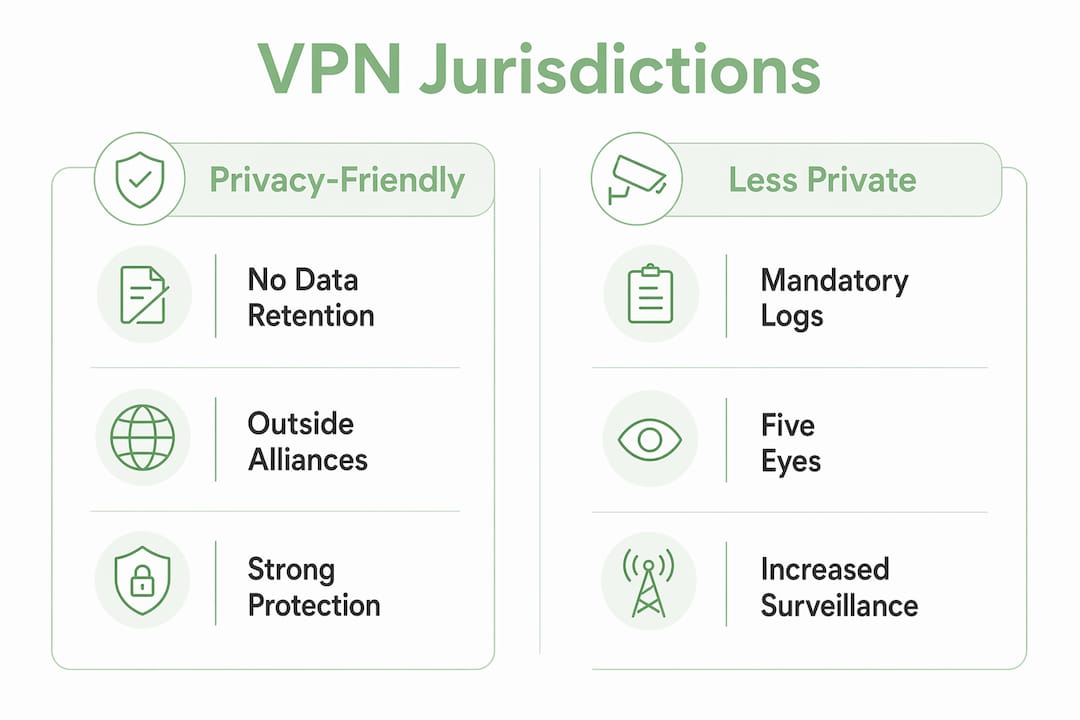
What jurisdiction can and cannot tell you about a VPN’s privacy claims
Jurisdiction is a useful signal, but it is not a privacy verdict on its own. Jurisdiction describes legal pressure, not actual data handling. A VPN registered in a privacy-friendly country can still log everything you do. A VPN in a Five Eyes country can still operate a genuine no-logs service if it never collects data in the first place. The law can only compel production of data that exists.
This is the most misunderstood point in VPN marketing. Providers often lead with their offshore status as if location alone guarantees privacy. It does not. What actually protects you is a combination of factors:
- Independent audits: Third-party firms like Cure53 or KPMG audit VPN providers’ systems and code to verify no-logs claims. An audit from a credible firm carries far more weight than a jurisdiction claim.
- Transparency reports: Providers that publish regular transparency reports, listing government requests received and how they responded, demonstrate accountability that geography alone cannot provide.
- Ownership disclosure: Some VPN brands are owned by larger parent companies registered in different countries. The parent company’s jurisdiction may override the brand’s stated location.
- Infrastructure transparency: Where servers physically sit, who owns the data centers, and whether the provider uses RAM-only servers all affect real-world privacy more than the legal address on a company registration form.
No-logs policies depend on technical design, not location. A provider that never writes connection logs to disk cannot produce them under any court order, regardless of which country issued it. That is the actual privacy protection. Jurisdiction tells you about legal risk. Audits and architecture tell you about real-world data exposure.
Comparing privacy-friendly VPN jurisdictions
Not all jurisdictions carry the same risk. Some countries have built reputations as genuinely privacy-protective legal environments, while others are known for aggressive surveillance or mandatory cooperation with foreign governments.
| Jurisdiction | Data Retention Laws | Eyes Alliance | Privacy Reputation |
|---|---|---|---|
| Panama | None | Outside all alliances | Strong privacy protection |
| Switzerland | Limited, court-ordered only | Outside all alliances | Strong, with independent courts |
| British Virgin Islands | None | Outside all alliances | Frequently used by privacy-focused VPNs |
| United States | No federal mandate, but FISA courts | Five Eyes | High surveillance risk |
| United Kingdom | Investigatory Powers Act requires retention | Five Eyes | High surveillance risk |
| Germany | Mixed; some retention struck down | Fourteen Eyes | Moderate risk |
Panama, Switzerland, and the British Virgin Islands appear repeatedly among privacy-conscious providers because their legal systems do not require data retention and sit outside intelligence-sharing alliances. Switzerland adds an extra layer: its courts are independent and its privacy laws are enforced domestically, meaning foreign governments cannot easily bypass Swiss legal process.
Countries inside the Five Eyes, including the United States, United Kingdom, Canada, Australia, and New Zealand, carry the highest risk for users who need strong privacy protections. The Investigatory Powers Act in the UK, for example, grants broad surveillance authority and compels companies to assist with interception. For most casual users, this may not matter much. For journalists, activists, or digital nomads working in sensitive environments, it matters a great deal.
Pro Tip: Check whether your VPN provider’s parent company is registered in a different country than the brand itself. Several well-known privacy brands are owned by holding companies in Five Eyes countries, which can override the brand’s stated jurisdiction.
Recent legal developments that change the jurisdiction picture
Laws are catching up with VPN use in ways that complicate the traditional jurisdiction argument. Utah’s SB 73, which took effect in May 2026, is a clear example. Utah’s SB 73 treats users as located in Utah based on their physical presence, not their IP address. This means a person physically in Utah using a VPN to appear located elsewhere is still subject to Utah law. The law also bans websites from sharing instructions on how to use VPNs to circumvent its requirements.
This “location follows the body” principle is a direct challenge to the idea that VPNs can reliably shift your legal jurisdiction. Key implications include:
- Digital nomads working remotely in jurisdictions with restrictive laws cannot assume a VPN changes their legal obligations.
- Website operators in other states or countries may face liability for content accessible to Utah residents, regardless of IP masking.
- VPN providers themselves may face new compliance questions if their services are used to circumvent state-level regulations.
Cross-border law enforcement adds another layer of risk. Operation Saffron, running from 2021 to 2026, demonstrated that Europol and partner agencies can physically seize VPN infrastructure across multiple countries, exposing user databases even when the provider’s legal seat is offshore. Jurisdiction affects the ability to compel data legally, but it does not prevent physical seizure of servers. For high-risk users, this distinction is critical. For casual users browsing safely on public Wi-Fi, the practical risk remains low.
How to evaluate a VPN’s jurisdiction risks in practice
Knowing what VPN jurisdiction means is only useful if you act on it. Here is a practical checklist for evaluating any VPN provider before you trust it with your data:
- Verify the legal entity: Look up the company registration, not just the marketing address. Use official business registries where available.
- Check for independent audits: Providers audited by firms like Cure53, Deloitte, or KPMG have verified their no-logs claims with external scrutiny. No audit means no verification.
- Read the transparency report: A provider that publishes how many government requests it received, and how it responded, is demonstrating real accountability.
- Understand ownership: Search for the parent company. If a privacy-focused brand is owned by a holding company in a Five Eyes country, the brand’s jurisdiction claim is weakened.
- Assess infrastructure: RAM-only servers cannot retain logs after a reboot. Providers that use this architecture add a technical layer of protection that jurisdiction alone cannot replicate.
- Match to your threat model: A casual user protecting themselves on café Wi-Fi has very different needs than a journalist in a high-risk country. Your jurisdiction requirements should match your actual risk level.
Pro Tip: For a broader look at evaluating VPN privacy policies, including what to look for beyond jurisdiction, it helps to understand the full range of privacy features a provider should offer.
Key takeaways
VPN jurisdiction is a critical input for assessing legal risk, but it only delivers real privacy protection when combined with verified no-logs policies, independent audits, and transparent ownership disclosure.
| Point | Details |
|---|---|
| Jurisdiction defines legal exposure | The provider’s country of incorporation determines which courts can compel data production. |
| Server location is a separate layer | Authorities can seize servers locally but cannot force an offshore company to produce data it never collected. |
| Audits matter more than location | Independent audits from firms like Cure53 verify no-logs claims in ways that jurisdiction alone cannot. |
| New laws complicate IP-based privacy | Utah’s SB 73 shows that physical presence, not IP address, now determines legal jurisdiction in some U.S. states. |
| Threat modeling is personal | Casual users and high-risk individuals need different levels of jurisdictional protection based on their actual exposure. |
Why jurisdiction is just one piece of the puzzle
By Darius Helzinski
After years of watching VPN marketing evolve, I have seen jurisdiction claims go from a niche technical detail to a headline selling point. Providers plaster “Panama-based” or “outside 14 Eyes” on their homepages as if geography is a privacy guarantee. It is not, and I think leaning too hard on that claim does users a disservice.
The providers I trust most are not necessarily the ones with the most exotic legal addresses. They are the ones that publish audits, disclose ownership honestly, and build technical architectures that make logging structurally impossible. A RAM-only server in a Five Eyes country is arguably safer than a log-happy provider in Panama, because the law can only compel what exists.
Utah’s SB 73 is a preview of where regulation is heading. Lawmakers are learning that IP addresses are not reliable proxies for physical location, and they are writing laws accordingly. The “hop offshore and you’re free” model of VPN privacy is getting harder to sustain as legal frameworks catch up. My honest advice: treat jurisdiction as one data point in a longer checklist, not the headline feature. Combine it with audit history, ownership transparency, and a realistic assessment of your own threat model. That combination is what actually keeps you private.
— Darius Helzinski
Stay private with Rapidrabbit

Rapidrabbit is built for people who want real privacy without a technical degree. It runs on WireGuard, widely regarded as the gold standard for VPN efficiency and security, and works on Windows, Linux, and Android today, with iOS coming soon. You do not need to understand every detail of how Rapidrabbit protects your data to benefit from it. Just tap the carrot and you are protected. Whether you are on public Wi-Fi at an airport, working remotely as a digital nomad, or simply keeping advertisers out of your business, Rapidrabbit keeps your connection private and fast. For travelers and mobile users, pairing a solid VPN with mobile security best practices adds another layer of protection that jurisdiction alone cannot provide. Try Rapidrabbit FREE and start browsing privately today.
FAQ
What is VPN jurisdiction in simple terms?
VPN jurisdiction is the country where your VPN provider is legally registered, and it determines which government and courts can legally demand your data. It is the provider’s legal home base, not where its servers are located.
Does VPN jurisdiction guarantee my privacy?
No. Jurisdiction describes legal pressure, not actual data handling. A provider in a privacy-friendly country can still log your activity, while one in a Five Eyes country can protect you if it never collects data in the first place.
Which VPN jurisdictions are considered most privacy-friendly?
Panama, Switzerland, and the British Virgin Islands are widely regarded as favorable because they have no mandatory data retention laws and sit outside the Five, Nine, and Fourteen Eyes intelligence alliances.
Can a VPN change my legal jurisdiction?
Not reliably. Utah’s SB 73 establishes that your physical location, not your IP address, determines your legal jurisdiction in that state. A VPN masks your IP but does not change where your body is.
What should I check beyond a VPN’s jurisdiction?
Look for independent audits from firms like Cure53 or Deloitte, published transparency reports, RAM-only server infrastructure, and clear ownership disclosure. These factors verify privacy claims that jurisdiction alone cannot confirm.