How OpenVPN Works Explained for Network Administrators

OpenVPN is an open-source VPN protocol that creates encrypted tunnels over the internet by separating authentication and data transmission into two distinct channels. This dual-channel architecture is the core of how OpenVPN works explained at a technical level: a control channel handles TLS/SSL handshakes and key negotiation, while a data channel carries your encrypted packets. Understanding both channels, the cryptographic mechanisms behind them, and how tunneling modes affect traffic routing gives you the full picture of how VPN security actually functions under the hood.
How OpenVPN’s dual-channel architecture secures your connection
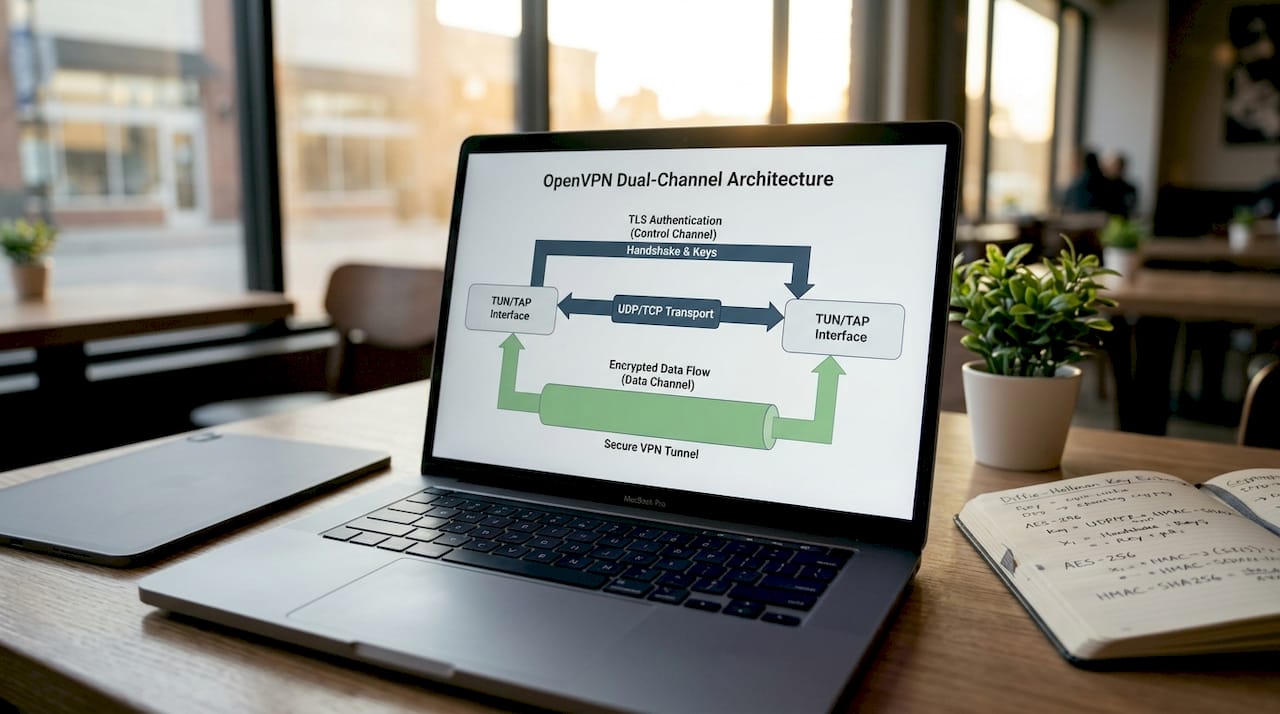
OpenVPN explicitly separates responsibilities between the control channel and the data channel. This is not a cosmetic design choice. It means cryptographic session management and high-speed packet encryption never compete for the same resources or share the same failure modes.
The control channel runs over TLS/SSL and handles everything that happens before a single byte of your actual traffic moves. That includes:
- Peer authentication: Both client and server verify each other’s certificates before any session begins.
- Key material derivation: The TLS handshake generates the symmetric keys that the data channel will use for encryption.
- Session parameter negotiation: Cipher suites, compression settings, and protocol options are agreed upon here.
- Renegotiation: Keys are periodically refreshed without dropping the connection, limiting exposure if a key is ever compromised.
The data channel then takes over for all actual traffic. It compresses, fragments, encrypts, and authenticates each packet in a bidirectional pipeline. Outbound packets are compressed, fragmented to fit MTU constraints, encrypted with the negotiated symmetric cipher, and then authenticated. Inbound packets reverse that sequence exactly.
OpenVPN also uses a three-level context hierarchy in control channel state management. Context levels c1 and c2 maintain pre-connection state and active session state respectively, which is what allows OpenVPN to support multiple simultaneous client connections and handle key renegotiations without interrupting live sessions. This is the kind of architectural detail that separates a well-engineered protocol from a fragile one.
Pro Tip: If you are troubleshooting dropped connections or slow renegotiation, check your control channel logs separately from data channel logs. Because the two channels operate independently, the failure is almost always isolated to one side, which cuts your diagnostic time significantly.
What encryption algorithms does OpenVPN use?
OpenVPN’s cryptographic subsystem supports both modern AEAD cipher modes and legacy modes, and the difference between them matters for both security and performance.
AEAD ciphers such as AES-256-GCM and ChaCha20-Poly1305 combine encryption and authentication into a single cryptographic operation. Legacy modes like AES-256-CBC, OFB, and CFB separate those two steps, requiring a distinct HMAC pass after encryption. That extra step adds CPU overhead and introduces a small but real window where an attacker could manipulate ciphertext before authentication catches it.
| Feature | AEAD modes (AES-GCM, ChaCha20-Poly1305) | Legacy modes (CBC, OFB, CFB) |
|---|---|---|
| Encryption + authentication | Combined in one operation | Separate steps |
| Performance | Lower CPU overhead | Higher CPU overhead |
| Security profile | Stronger, no MAC-then-encrypt risk | Adequate, but more attack surface |
| Recommended for | All new deployments | Legacy compatibility only |
OpenVPN also provides replay protection through a packet ID and sliding window mechanism. Every incoming packet carries a packet ID, and OpenVPN checks it against a bitmap of recently seen IDs. Packets that fall outside the window or match an already-seen ID are rejected immediately. This prevents an attacker from capturing valid encrypted packets and replaying them later to trigger repeated actions on the server.
The cryptographic backend is abstracted, meaning OpenVPN can run on top of OpenSSL, mbed TLS, or wolfSSL depending on your platform and licensing requirements. OpenSSL is the default and most widely tested. wolfSSL is favored in embedded or resource-constrained environments. The abstraction layer means cipher selection and backend choice are independent decisions, which gives administrators real flexibility.
Pro Tip: Cipher selection directly impacts CPU load. On high-throughput servers, switching from AES-256-CBC to AES-256-GCM can reduce cryptographic processing time noticeably, especially on hardware with AES-NI acceleration. Always benchmark before and after any cipher change in production.
How does TLS-Crypt protect the control channel?
Standard TLS protects the content of the control channel, but it does not hide the fact that you are running OpenVPN. TLS-Crypt solves that by wrapping control channel packets in an additional layer of shared-key encryption and authentication before TLS even begins.
TLS-Crypt encrypts and authenticates control packets using a pre-shared key that both client and server hold. The practical effects are significant:
- Protocol obfuscation: Deep packet inspection tools and firewalls cannot identify the traffic as OpenVPN, which matters in restrictive network environments or regions with active censorship.
- DoS protection: Because the server can verify the TLS-Crypt HMAC before processing any TLS handshake, unauthenticated clients cannot force expensive cryptographic operations on the server. This is a real defense against handshake-flood attacks.
- Privacy: Even the metadata of the TLS negotiation is hidden from passive observers on the network path.
TLS-Crypt v2 extends this further by giving each client its own unique pre-shared key rather than a single shared key for all clients. This means a compromised client key does not expose every other client’s control channel traffic.
Authentication tokens complement TLS-Crypt by enabling password-free reconnection after the initial authentication. The server issues a token after the first successful login, including any two-factor authentication step. Subsequent reconnections use that token instead of prompting for credentials again. Tokens are managed server-side, so revoking access is immediate and does not depend on the client deleting anything locally.
One practical consideration: TLS-Crypt does make traffic harder to inspect, which affects your own firewall and monitoring tools as much as it affects an attacker. If your security operations center relies on DPI to log VPN session metadata, you need to account for that visibility loss when enabling TLS-Crypt.
Full tunneling vs split tunneling: which should you use?
Routing behavior in OpenVPN is controlled by server-push directives, not just client configuration files. This distinction matters because it means the server administrator, not the end user, determines how traffic flows.
-
Full tunneling is enabled with the "redirect-gateway` directive. Every packet from the client, including general internet traffic, routes through the VPN server. This maximizes privacy because the client’s real IP is never exposed to external services, and all DNS queries go through the VPN. The trade-off is higher load on the VPN server and increased latency for traffic that does not need VPN protection.
-
Split tunneling uses the
redirect-privatedirective instead. Only traffic destined for specific private subnets routes through the VPN. Everything else goes directly to the internet via the client’s local connection. This reduces server load and improves performance for general browsing, but it means the client’s real IP is visible to any service outside the tunneled subnets. -
Leak risk is real with split tunneling. Many leak issues come from misconfigured route-push policies rather than encryption failures. If your
redirect-privatedirective does not cover all the subnets your application touches, traffic leaks outside the tunnel silently. -
DNS handling requires explicit configuration. In full tunnel mode, push a DNS server address to clients so their DNS queries do not bypass the VPN. In split tunnel mode, decide deliberately whether DNS should go through the tunnel or not, and configure accordingly.
-
Test your routing table after every configuration change. On Linux,
ip route showandip rule listshow exactly where packets are going. On Windows,route printdoes the same job. Do not assume the push directives worked. Verify them.
Proper routing control via server-push directives is the single most important factor in preventing data leaks and achieving the privacy posture you actually want.
Key takeaways
OpenVPN secures connections through a dual-channel architecture where TLS manages authentication and key exchange while symmetric AEAD ciphers handle all encrypted data transmission.
| Point | Details |
|---|---|
| Dual-channel design | Control channel handles TLS authentication; data channel handles encrypted packet transmission independently. |
| AEAD cipher advantage | AES-256-GCM and ChaCha20-Poly1305 combine encryption and authentication, reducing CPU overhead versus legacy CBC modes. |
| TLS-Crypt protection | Encrypts control packets with a pre-shared key, blocking DPI identification and defending against handshake-flood DoS attacks. |
| Tunneling mode selection | Full tunneling routes all traffic through the VPN; split tunneling routes only private subnets, with leak risk if misconfigured. |
| Replay protection | Packet ID sliding window rejects duplicate or out-of-range packets, preventing replay attacks on the data channel. |
OpenVPN’s architecture rewards administrators who read the source
I have spent years configuring and auditing VPN deployments, and OpenVPN’s design consistently impresses me for one specific reason: the separation of concerns is genuine, not cosmetic. Most protocols claim clean architecture. OpenVPN actually delivers it. The control channel and data channel fail independently, log independently, and tune independently. That makes debugging faster and security audits cleaner.
The cipher debate comes up constantly in enterprise deployments. My position is straightforward: if your hardware supports AES-NI, run AES-256-GCM and stop thinking about it. If you are on ARM or embedded hardware without AES acceleration, ChaCha20-Poly1305 is the right call. The performance difference is measurable, and the security profiles are both strong. What I see too often is administrators leaving AES-256-CBC in place because it was the default years ago. That is not a security catastrophe, but it is unnecessary overhead.
TLS-Crypt is underused. I understand why: it adds a key management step and reduces visibility for your own monitoring tools. But in any environment where you face deep packet inspection, whether that is a corporate network, a restrictive ISP, or a high-censorship region, TLS-Crypt is not optional. It is the difference between a VPN that works and one that gets blocked at the first hop.
The MTU and fragmentation issue is where I see the most unexplained instability. Random disconnects, degraded throughput, and intermittent packet loss are almost always MTU problems in disguise. Set your tun-mtu and fragment directives explicitly. Do not rely on path MTU discovery to get it right. It often does not, especially across networks with inconsistent ICMP handling.
For anyone evaluating VPN services, understanding why a VPN matters at the protocol level is the foundation for making a good choice. The architecture described here is what separates a well-implemented VPN from one that looks secure on paper but leaks in practice.
— Darius Helzinski
See how Rapidrabbit puts this into practice
If reading through OpenVPN’s architecture has you thinking about what a well-implemented VPN actually looks like in production, Rapidrabbit is worth a look.

Rapidrabbit runs on Windows, Linux, and Android, with iOS coming soon. It uses WireGuard, which delivers the same principles of clean cryptographic separation and strong authentication that make OpenVPN compelling, but with a leaner codebase and faster handshakes. You get encrypted tunnels, protection on public Wi-Fi in airports and cafés, and the ability to hop around the web without exposing your real IP. No technical setup required. Just tap the carrot and you are protected. Explore how Rapidrabbit works and see the architecture behind the privacy. FREE TRIAL AVAILABLE at Rapidrabbit.
FAQ
What is OpenVPN and how does it differ from other VPN protocols?
OpenVPN is an open-source VPN protocol that uses TLS/SSL for control channel authentication and symmetric encryption for data channel packet transmission. Unlike WireGuard, which uses a fixed modern cipher suite, OpenVPN supports a wide range of cryptographic backends including OpenSSL, mbed TLS, and wolfSSL.
How does the OpenVPN control channel work?
The control channel performs a TLS/SSL handshake to authenticate both peers and derive the session keys used by the data channel. It also handles periodic key renegotiation without dropping the active connection.
What is TLS-Crypt in OpenVPN?
TLS-Crypt encrypts and authenticates control channel packets using a pre-shared key, hiding the VPN protocol from deep packet inspection tools and protecting the server from unauthenticated handshake-flood attacks.
What is the difference between full and split tunneling in OpenVPN?
Full tunneling routes all client traffic through the VPN using the redirect-gateway directive, while split tunneling routes only specific private subnets using redirect-private. Misconfigured route-push policies are the leading cause of traffic leaks in split tunnel deployments.
Does OpenVPN protect against replay attacks?
Yes. OpenVPN uses a packet ID sliding window to detect and reject duplicate or out-of-range packets, preventing attackers from replaying captured encrypted traffic against the server.